A Metacognitive Framework for Test-Time Adaptation: Taxonomy and Research Challenges
AAAI 2026 Fall Symposium on Artificial Metacognition (METACOG-26), Top 3 paper
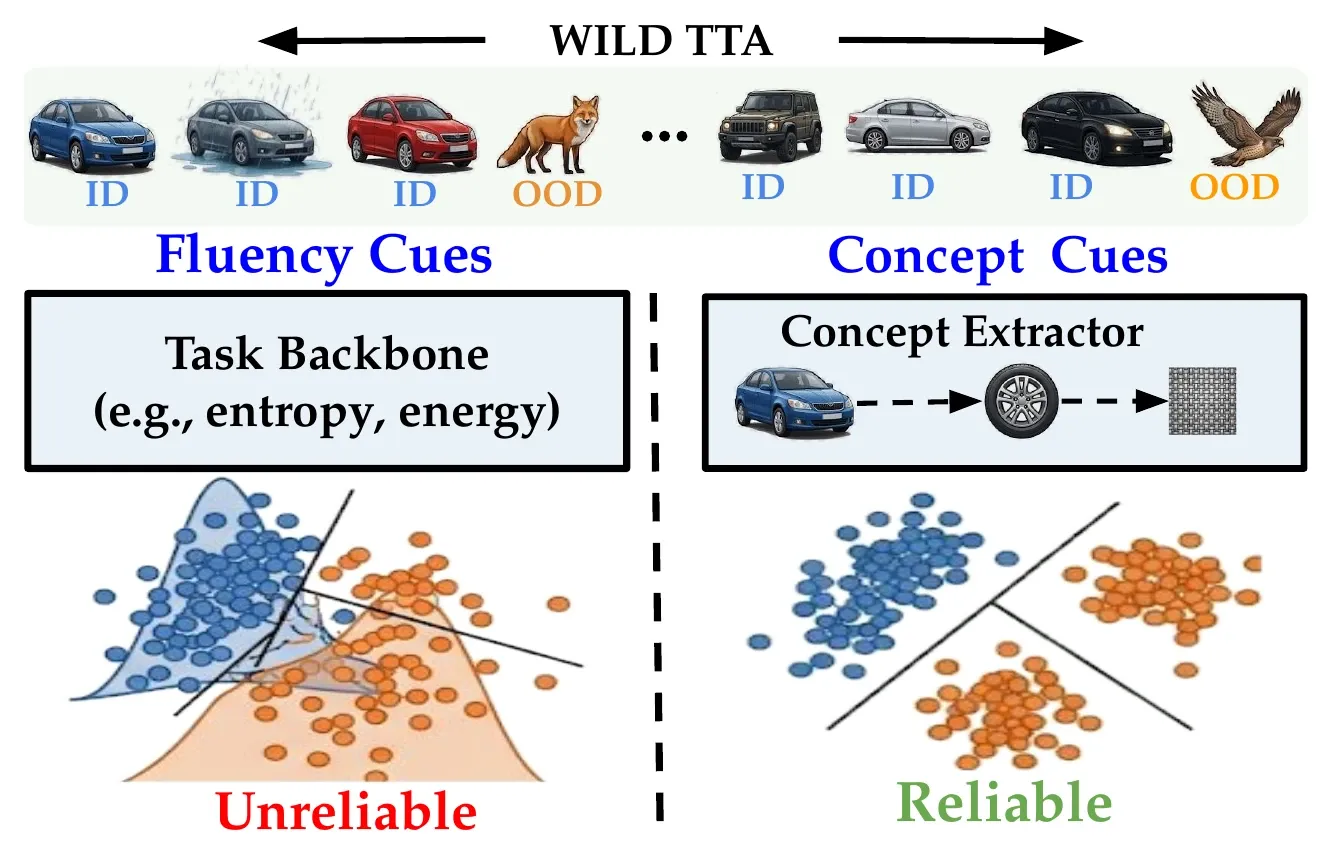
In short A two-level metacognitive framework for test-time adaptation that separates task execution from control, with a taxonomy of existing methods and the open challenges ahead.
Abstract
In Test-Time Adaptation (TTA), when out-of-distribution samples interleave unpredictably with corrupted in-distribution samples, adaptation without corrective measures is prone to significant performance decrease. Existing protocols rely on unreliable factors (e.g., predictive entropy) which are unable to distinguish corrupted in-distribution data from semantically novel open-set samples. To address this issue, we formalize TTA through a two-level metacognitive framework that decouples task execution from control, facilitating a unified taxonomy that categorizes existing TTA protocols across three core axes, i.e., which knowledge is monitored, which part of the models are targeted for adaptation, and how adaptation occurs. We provide evidence that robust corrective measures in TTA require monitoring grounded in structured internal representations to reliably estimate model competence. Lastly, we frame monitoring as a resource-allocation problem, examine neuromorphic substrates for bounded self-regulation, and outline key open challenges.
Cite
@inproceedings{loi2026metacognitive,
  title     = {A Metacognitive Framework for Test-Time Adaptation: Taxonomy and Research Challenges},
  author    = {Dario Loi and Gabriele Onorato and Antonella Coviello and Shahriar Rifat and Nathaniel D. Bastian and Francesco Restuccia},
  booktitle = {AAAI 2026 Fall Symposium on Artificial Metacognition (METACOG-26)},
  year      = {2026},
  url       = {https://mentis.info/wp-content/uploads/2026/09/Concept_TTA_AAAI26-Metacog.pdf}
}