Implicit Sheaf Operators for Effective and Efficient Cellular Sheaf Learning
Preprint, August 2026
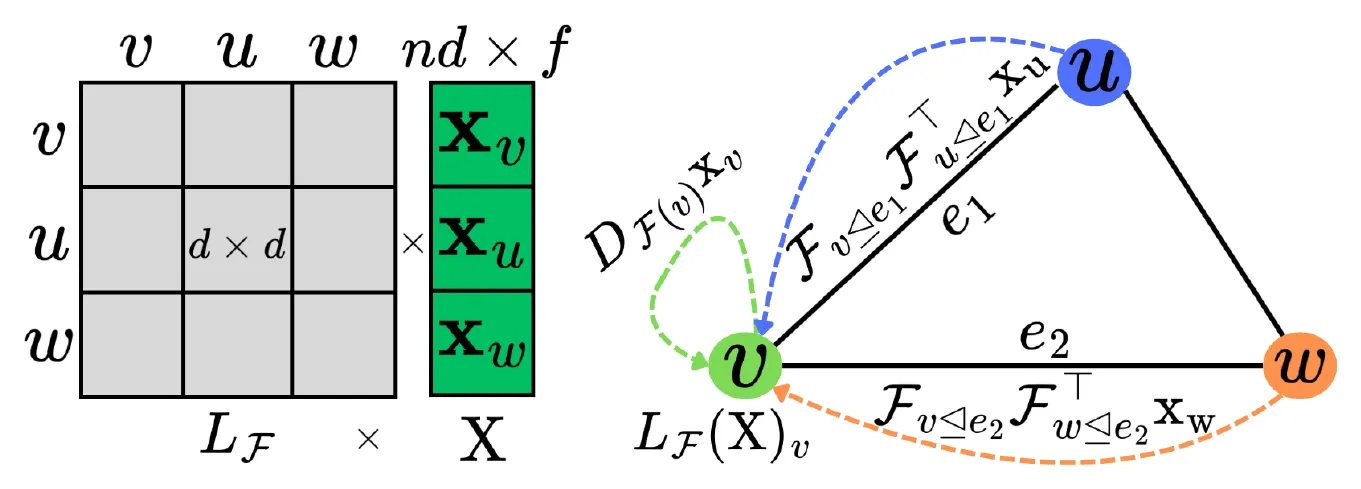
In short Implicit Sheaf Operators compute sheaf diffusion as local operator-vector products instead of building the sheaf Laplacian, with up to 4.87× lower latency and 3.92× less peak GPU memory.
Abstract
While Sheaf Neural Networks (SNNs) enrich -node -edge diffusion of -dimensional node features with -dimensional node and edge stalks, they require computing a sparse sheaf Laplacian, whose computation is prohibitive on edge devices. This paper addresses this issue with Implicit Sheaf Operators (ISOs), a type of sheaf topological operators that leverage the topological structure of cellular sheaves to decompose the global diffusion process into local operator-vector products. We mathematically prove that ISO eliminates the sparse-coalescing term and reduces the space complexity by with respect to traditional Neural Sheaf Diffusion (NSD). Our experiments indicate that ISO-based operators achieve latency reduction of up to 4.87× and save up to 3.92× peak GPU memory. On real graph classification data, ISO uses up to 1.24× less energy and 3.08× less on-device memory as measured on a Jetson Orin Nano. Finally, to bring ISO to practice, we introduce Sheaf Convolutional Networks (SCNs), an ISO-based SNN attaining up to 3.93% higher accuracy compared to NSD-based SNNs on node classification benchmarks.
Cite
@misc{onorato2026implicit,
  title  = {Implicit Sheaf Operators for Effective and Efficient Cellular Sheaf Learning},
  author = {Gabriele Onorato and Dario Loi and Cristian Apostol and Nathaniel D. Bastian and Francesco Restuccia},
  year   = {2026},
  note   = {Preprint},
  url    = {https://mentis.info/wp-content/uploads/2026/08/SheafOperators.pdf}
}