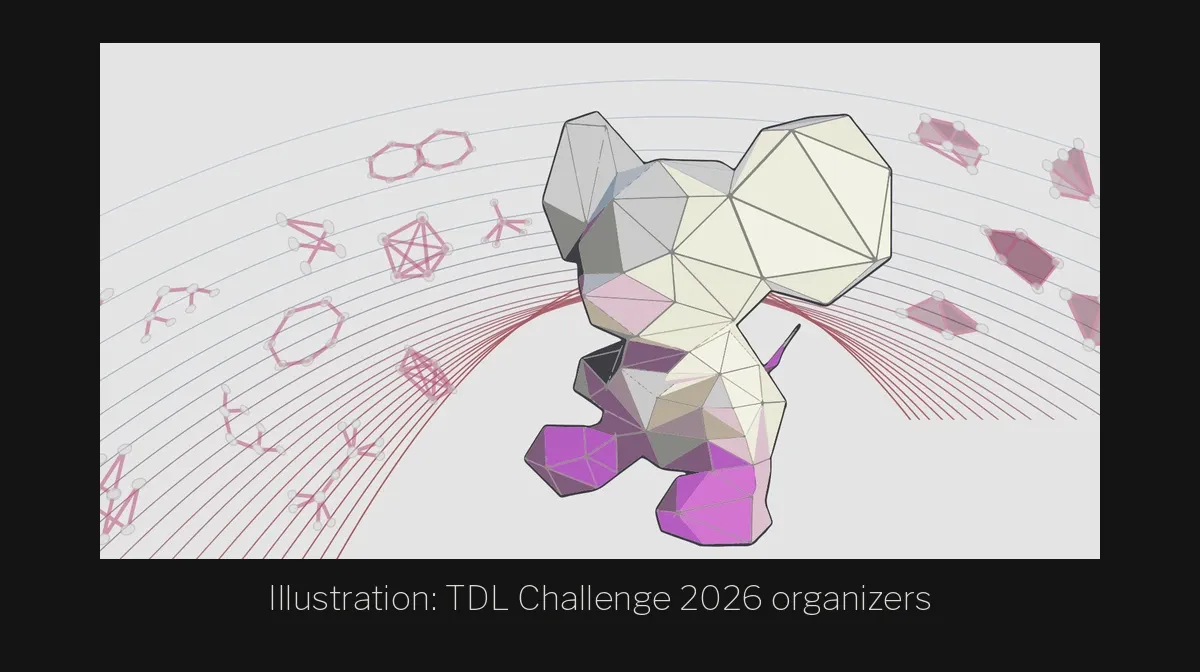
In short The 2026 Topological Deep Learning Challenge put graph neural networks and higher-order topological neural networks side by side in TopoBench, on synthetic graphs whose structure is set by design, and found that which family does better depends on the task. Our implementation of the directed sheaf neural network took first place in the graph neural network track.
Abstract
This paper describes the 2026 edition of the Topological Deep Learning Challenge: Bridging the Gap, hosted at the second Topology, Algebra, and Geometry in Data Science (TAG-DS) Conference. Where previous editions grew the modelling and data ecosystem of Topological Deep Learning (TDL), this edition set out to place Graph Neural Networks (GNNs) and Topological Neural Networks (TNNs) side by side under a single evaluation pipeline. Participants implemented recent state-of-the-art architectures in TopoBench, with Track 1 covering GNNs and Track 2 covering TNNs. They evaluated these implementations on shared synthetic benchmarks generated with GraphUniverse, which independently controls homophily, average degree and degree-distribution heaviness. The challenge yielded 68 qualifying submissions from 34 teams, spanning the graph, simplicial, cellular, hypergraph and combinatorial domains. For the first time, submissions were also tracked on a public leaderboard, which we summarize and analyze here. Our analysis finds that the differences between the submitted tracks are strongly task-dependent: the mean accuracy gap is modest on community detection, while on triangle counting the Track 1 mean error is 1.85 times the Track 2 mean. Several structurally informed GNNs also outperform the Track 2 mean on triangle counting.
Suppose a graph neural network (GNN) and a topological neural network (TNN) both claim to be good at spotting triangles in a network. The two papers use different datasets, different splits, and different code, so the comparison says little about which family is the better tool. The 2026 Topological Deep Learning Challenge set out to remove that excuse. It asked participants to implement recent architectures in TopoBench, the open-source benchmarking library for topological deep learning (TDL), and to run all of them through one evaluation pipeline on graphs whose structure is set by design.
This page is a companion to the report. It explains what made this edition different from the 2025 one, what a GNN vs topological neural network benchmark can and cannot tell a practitioner, and what Gabriele Onorato and I submitted as team howyadoin, including the winner of Track 1.
How the challenge worked
Participants chose one of two tracks. Track 1 covered GNNs, i.e., message passing on plain graphs, including graph transformers with structural encodings. Track 2 covered TNNs, which use higher-order message passing over simplicial complexes, cell complexes, hypergraphs, and combinatorial complexes. Every submission was a pull request against TopoBench that had to pass continuous integration, with tests, linting, and formatting checks.
The field was 34 teams and 45 registered participants, and the split between tracks was close to even (see the chart). A panel of TopoBench maintainers and collaborators decided the awards by Condorcet vote on four criteria: correctness, code quality, benchmarking on the GraphUniverse datasets, and documentation and tests. The criteria reward careful, reusable implementations, so every edition leaves TopoBench with more models that others can build on.
Why synthetic graphs from GraphUniverse
Real benchmarks bundle many properties at once, so when a model wins it is hard to say why. GraphUniverse is a framework for sampling synthetic graphs, and here it let the organizers vary three properties independently: homophily (how often neighbors share a label), average degree, and how heavy-tailed the degree distribution is. Each GraphUniverse dataset is therefore a small controlled experiment, and the same grid of graphs is given to every model, whatever its domain. Concretely, homophily takes three levels, average degree two, and the degree-distribution exponent two, which gives 12 configurations with three training seeds each.
What the comparison suggests
The report's main finding is that the difference between the tracks depends on the task. On community detection the mean accuracy gap is modest. On triangle counting, where the answer is a higher-order quantity by definition, the average error of Track 1 is 1.85 times that of Track 2. The report also finds that several structurally informed GNNs beat the Track 2 mean on triangle counting.
For someone choosing a model, both results are useful. The triangle-counting gap is consistent with the case for encoding higher-order structure, whereas the structurally informed GNNs show that a graph model with good structural features is a serious contender. The natural next step is real data, where homophily, degree, and tail weight come tangled together.
My contribution
Gabriele Onorato and I competed as team howyadoin and submitted five models, all from the sheaf family: three in Track 1 and two in Track 2. Our implementation of the Directed Sheaf Neural Network (DSNN, from Fiorini et al., ICLR 2026) took first place in Track 1 (Graph Neural Networks), and the team received the honorable mention "Excellent portfolio", given to two teams for "multiple high-quality contributions across both tracks".
DSNN (pull request #412) is a directed sheaf neural network implementation in PyTorch. Its restriction maps carry a phase read off the adjacency, which gives a Hermitian directed sheaf Laplacian that reduces to the ordinary one on undirected graphs. We implemented it with a real-valued lifting, so no complex tensor is ever materialized. The pull request carries 223 unit tests that check the paper's theorems rather than tensor shapes, full line coverage of its new files, API documentation, and a notebook that reproduces the paper's directed stochastic block model figure, where only edge directions reveal the communities. For readers who care about speed, our own work on sheaf networks is in Implicit Sheaf Operators.
The other four models are Sheaf Attention Networks (#322) and Neural Sheaf Propagation (#326) in Track 1, and the Copresheaf Topological Neural Network (#405) and the Directional Sheaf Hypergraph Network (#408) in Track 2. Across the five pull requests we wrote more than 400 unit tests; for DSNN, the copresheaf network, and the hypergraph network, they check the equations and theorems of the original papers directly.
References
- Federico Barbero, Cristian Bodnar, Haitz Sáez de Ocáriz Borde, and Pietro Liò (2022). Sheaf Attention Networks. NeurIPS 2022 Workshop on Symmetry and Geometry in Neural Representations.
- Stefano Fiorini, Hakan Emre Aktas, Iulia Duta, Pietro Morerio, Alessio Del Bue, Pietro Liò, et al. (2026). Sheaves Reloaded: A Direction Awakening. International Conference on Learning Representations (ICLR 2026). arXiv
- Mustafa Hajij, Lennart Bastian, Sarah Osentoski, Hardik Kabaria, John Davenport, Sheik Dawood, et al. (2025). Copresheaf Topological Neural Networks: A Generalized Deep Learning Framework. Advances in Neural Information Processing Systems 38 (NeurIPS 2025).
- Louis Emiel T Van Langendonck, Guillermo Bernardez, Nina Miolane, and Pere Barlet-Ros (2026). GraphUniverse: Synthetic Graph Generation for Evaluating Inductive Generalization. International Conference on Learning Representations (ICLR 2026). arXiv
- Emanuele Mule, Stefano Fiorini, Antonio Purificato, Federico Siciliano, Stefano Coniglio, and Fabrizio Silvestri (2026). Directional Sheaf Hypergraph Networks: Unifying Learning on Directed and Undirected Hypergraphs. International Conference on Learning Representations (ICLR 2026). arXiv
- Julian Suk, Lorenzo Giusti, Tamir Hemo, Miguel Lopez, Konstantinos Barmpas, and Cristian Bodnar (2022). Surfing on the Neural Sheaf. NeurIPS 2022 Workshop on Symmetry and Geometry in Neural Representations.
- Lev Telyatnikov, Guillermo Bernardez, Marco Montagna, Mustafa Hajij, Martin Carrasco, Pavlo Vasylenko, et al. (2025). TopoBench: A Framework for Benchmarking Topological Deep Learning. Journal of Data-centric Machine Learning Research. arXiv
Cite
@inproceedings{pmlr-v334-bernardez26a,
  title     = {Topological Deep Learning Challenge 2026: Bridging the Gap},
  author    = {Bern{\'a}rdez, Guillermo and Telyatnikov, Lev and Papillon, Mathilde and Montagna, Marco and Cornelis, Louisa and Van Langendonck, Louis and Purificato, Antonio and Neri, Bruno and Leko, David and Genovese, Donatella and Grassucci, Eleonora and Van Looy, Jan-Willem and Mathe, Johan and Testa, Lucia and Beni{\'c}, Luka and Weber, Melanie and Zaghen, Olga and Vasylenko, Pavlo and Theiler, Raffael and Mahan, Scott and Khanal, Gaurav and S{\'a}nchez, Valentina and Loi, Dario and Onorato, Gabriele and Devadiga, Prasanna and Paik, Taejin and Velasco Sotomayor, Anier and M{\"u}ller, Jonas and Gupta, Aarav and Patel, Riyan and Mboya, Grold Otieno and Devadiga, Pushparaj and Gohain, Adam and Filipiak, Dominik and Banf, Michael and Mohammadian, Alireza and Akbari, Amirreza and Chaviano D{\'i}az, Gabriel and Ch{\'a}vez Mesa, Marcos and Grover, Ankit and Bourgerie, R{\'e}mi and Comparini, Alessio and Kumar, Ankit and Yusuf, Mohammad and Kaushal, Devesh and Orsi, Francesco and Mostofi, Ghazal and Lettl, Kolya and Khattami, Salwa and Franco, Gabriel and Falkouskaya, Yelizaveta and Franco, Jorge Luiz and Singla, Kajal and Espinosa I{\~n}iguez, Fernando David and Patil, Raj and Dolores-Cuenca, Eric and Petti, Luigi and Xu, Chenguang and Blando, Stefano and Zeh, Christine and Bastian, Lennart and Zheng, Kaden and Tiwari, Vihan and Athreya, Sud and Kajita, Hisataka and Micheron, Hugo and Devaux, R{\'e}mi and Jardin, Antoine and Emerson, Tegan and Fink, Olga and Miolane, Nina},
  booktitle = {Proceedings of the 2nd Conference on Topology, Algebra, and Geometry in Data Science (TAG-DS 2026)},
  pages     = {4--29},
  year      = {2026},
  volume    = {334},
  series    = {Proceedings of Machine Learning Research},
  publisher = {PMLR},
  url       = {https://proceedings.mlr.press/v334/bernardez26a.html}
}