In short The 2025 Topological Deep Learning Challenge asked the community to extend TopoBench with new datasets, benchmark tasks, and data pipelines. This report describes the challenge and what it received.
Abstract
This paper describes the 2025 edition of the Topological Deep Learning Challenge: Expanding the Data Landscape, hosted at the first Topology, Algebra, and Geometry in Data Science (TAG-DS) Conference. This year’s challenge aimed to address the data bottleneck in the field by systematically expanding the ecosystem of Topological Deep Learning (TDL). Powered by TopoBench, the challenge was organized into two primary missions: enriching the data landscape with diverse datasets, and advancing core data infrastructure. In particular, participants were invited to contribute to the open-source platform by implementing new dataset loaders, designing new benchmark tasks, or engineering robust, scalable data pipelines. The initiative successfully yielded 44 qualifying submissions. This paper outlines the scope of the competition and summarizes the key results and findings, highlighting the new resources now available to the TDL community.
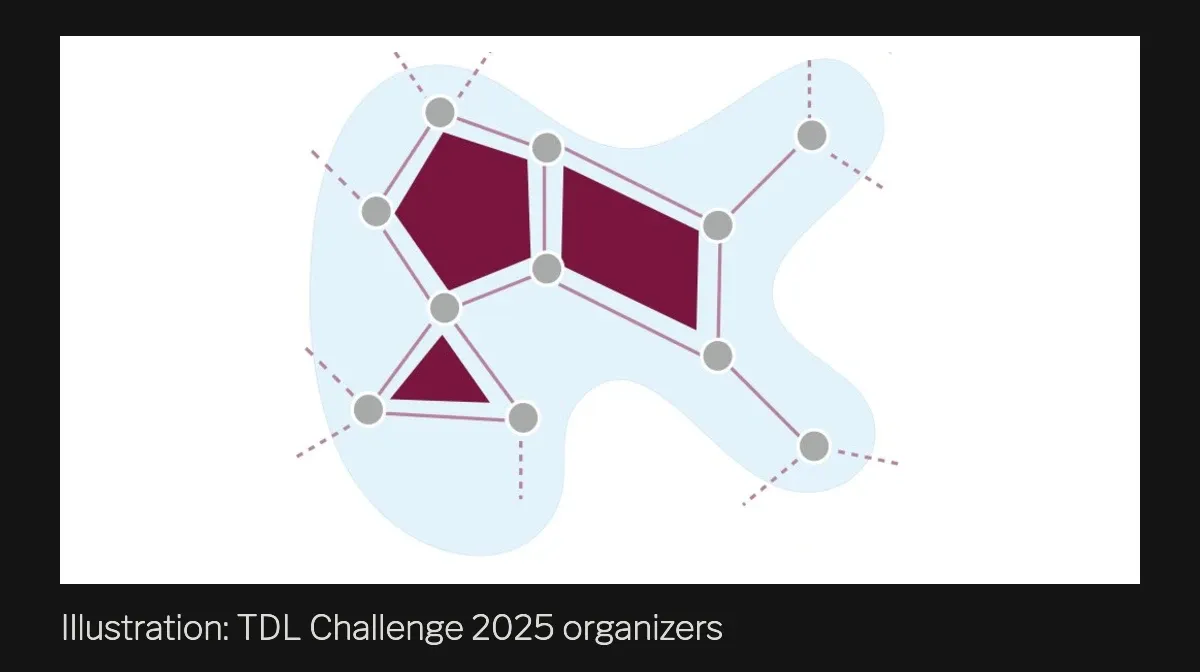
Most graph benchmarks describe a molecule as atoms joined by bonds. Chemists, however, reason about rings, functional groups, and other substructures that involve several atoms at once. Topological Deep Learning (TDL) builds neural networks for such higher-order relations, using hypergraphs, simplicial complexes, and cell complexes, yet the community has been evaluating these models on a handful of datasets (Papamarkou et al., 2024). When every new architecture is compared on the same few benchmarks, it is hard to tell whether an idea generalizes. The 2025 challenge, run at the first Topology, Algebra, and Geometry in Data Science (TAG-DS) conference, treated this as a data problem and asked the community to contribute to TopoBench, an open-source library for benchmarking topological neural networks. This page is a companion to the report.
How the challenge worked
Anyone could take part by opening a pull request against TopoBench. Each request had to pass the repository tests and add at most one dataset loader, so every contribution arrived as reviewable, runnable code. The organizers split the work into two missions. Mission A asked for dataset loaders, in two flavors: well-established graph and point cloud datasets (Category A.1), which connect TDL to mainstream graph learning, and datasets where higher-order structure is native to the data (Category A.2), such as hypergraphs and simplicial complexes. Mission B asked for infrastructure: loaders that read from disk so that large datasets avoid the memory cost of lifting to a higher-order domain (Category B.1), and new benchmark tasks, e.g., link prediction in hypergraphs (Category B.2).
Datasets in the challenge
The Mission A tables in the report list submissions ranging from social and citation networks (Facebook, Twitch, Coauthor_CS) and the Open Graph Benchmark to molecular graph datasets such as QM9 and MoleculeNet, protein interaction data, analog circuits, water distribution networks, and neuroscience data. The A.1 winner brought ATLAS Top Tagging, a benchmark from particle physics, into the library, and the A.2 winner contributed Cornell Labeled Nodes Hypergraphs, a set of 8 hypergraph datasets. For a researcher looking for molecular graph datasets for topological deep learning, or for hypergraph benchmarks beyond the usual citation graphs, this is a useful starting list, since all of them sit behind one interface.
The count was 44 submissions from 30 teams, with most of the effort in Mission A (see the chart). Reviewers judged correctness, code quality, documentation, and tests. Model accuracy was not part of the judging. What the submissions leave behind is reusable infrastructure.
Why it matters for benchmarking
A shared interface makes comparisons fairer: the same model can now be run on many more graphs and higher-order datasets without custom data code. The organizers frame the next step as systematic benchmarking across the new datasets, since it is still unclear which topological domains and liftings, i.e., the conversions of a graph into a hypergraph or complex, fit which application. The on-disk loaders, in the organizers' view, make larger-scale workloads possible, which they connect to cross-domain pretraining and topological foundation models. The report lists these directions as open questions that it does not test.
My contribution
I contributed a TopoBench loader for MoleculeNet (pull request #224) in Category A.1, the category for established graph and point cloud datasets.
References
- Theodore Papamarkou, Tolga Birdal, Michael M. Bronstein, Gunnar E. Carlsson, Justin Curry, Yue Gao, et al. (2024). Position: Topological Deep Learning is the New Frontier for Relational Learning. Proceedings of the 41st International Conference on Machine Learning, PMLR 235.
- Lev Telyatnikov, Guillermo Bernardez, Marco Montagna, Mustafa Hajij, Martin Carrasco, Pavlo Vasylenko, et al. (2025). TopoBench: A Framework for Benchmarking Topological Deep Learning. Journal of Data-centric Machine Learning Research. arXiv
- Zhenqin Wu, Bharath Ramsundar, Evan N. Feinberg, Joseph Gomes, Caleb Geniesse, Aneesh S. Pappu, et al. (2018). MoleculeNet: a benchmark for molecular machine learning. Chemical Science 9(2).
Cite
@InProceedings{pmlr-v321-bernardez26a,
  title = 	 {Topological Deep Learning Challenge 2025: Expanding the Data Landscape},
  author =       {Bern\'ardez, Guillermo and Telyatnikov, Lev and Papillon, Mathilde and Montagna, Marco and Theiler, Raffael and Cornelis, Louisa and Mathe, Johan and Ferriol, Miquel and Vasylenko, Pavlo and Van Looy, Jan-Willem and Testa, Lucia and Neri, Bruno and Genovese, Donatella and Weber, Melanie and Wei, Amaury and Devoto, Alessio and Weers, Alexander and Jankowski, Robert and Cino, Loris and Leko, David and Banf, Michael and M\"{u}ller, Jonas and Grapentin, Thomas and Paik, Taejin and Dutta, Abhijeet and Walter, Hugo and Fontanari, Thomas Vaitses and Ghasemi, Ali and Loi, Dario and S\'aez de Oc\'ariz Borde, Haitz and Aguilar-Arg\"uello, Gabriela and da Rosa, Giovanni B. and Saulus, Th\'eo and Dolores-Cuenca, Eric Rubiel and Di Nino, Leonardo and Leroy, Pierrick and Pandolfo, Mario Edoardo and Cavallo, Andrea and Qin, Yu and Snopov, Pavel and Akbari, Amirreza and Meza-Ch\'avez, Ixchel and Van Langendonck, Louis and Able, Jared and Meshcheryakova, Maria Yuffa and Tsay, Henry and Beni\'c, Luka and Filipiak, Dominik and Liu, Patrick and Liang, Huidong and Santos da Rosa Jr., Alexsandro and Cattai, Tiziana and Borges, Henrique M. and Grimaldi, Enrico and Lecha, Manuel and Battiloro, Claudio and Liu, Xuan-Chen and Deshpande, Raj and Johnson, Graham and Morgunov, Igor and Micheron, Hugo and Devaux, R\'emi and Jardin, Antoine and Emerson, Tegan and Fink, Olga and Miolane, Nina},
  booktitle = 	 {Proceedings of the 1st Conference on Topology, Algebra, and Geometry in Data Science(TAG-DS 2025)},
  pages = 	 {4--14},
  year = 	 {2026},
  editor = 	 {Bernardez Gil, Guillermo and Black, Mitchell and Cloninger, Alexander and Doster, Timothy and Emerson, Tegan and Garcı́a-Rodondo, Ińes and Holtz, Chester and Kotak, Mit and Kvinge, Henry and Mishne, Gal and Papillon, Mathilde and Pouplin, Alison and Rainey, Katie and Rieck, Bastian and Telyatnikov, Lev and Yeats, Eric and Wang, Qingsong and Wang, Yusu and Wayland, Jeremy},
  volume = 	 {321},
  series = 	 {Proceedings of Machine Learning Research},
  month = 	 {01--02 Dec},
  publisher =    {PMLR},
  url = 	 {https://proceedings.mlr.press/v321/bernardez26a.html},
}